Single Camera Theory
Soap Opera
Soap opera's, however are oftenly called Soaps in this generation they usually base from one single location to set a narrative and then follow the lives within that narrative and location, a few examples of "Soaps" would be Coronation Street, Hollyoaks, EastEnders, etc. whatever the mothers watch on a saturday night, Coronation street is a good example because its actually set in Coronation street.

Soap opera's have no specific way to how they are presented, as it is based through lives and a chain of events throughout the story, it can cut to anywhere any time and still fit together because the events are all seperated but in the same location, it is based around through a small town really that never gets out much, you dont see different locations like the Lake district or Area 59 it just sticks with the same one, or possibly from time to time a prison location but that is indoors. From time to time it will show the typical stereotypes as it makes a more mellow atmosphere coming from the writers, for example the homewrecker bad boy who causes disturbance in the family.
Serial Drama
A serial drama is a type of show that the plot gets continued through revealing more and more context in each episode, yes serial drama's are episode based as is this entire category, the name soap opera's do technically count as serial but mainly they work differently by consistently following the main story instead of having a coverage in one or two episodes its typically spread out in seasons.

Single Drama
A single drama is essentials completely different to a serial drama as unlike serial a single tells a narrative within one episode instead of spreading it across hundreds, this in the long run can be more beneficial as it will consist of different stories with the same characters elaborating their lives are more impressive and adventurous than meant to be.

The reason why I have chose this image is simply because each tells a different story so essentials this relates to what a single drama can be, it tells one story per episode but each episode they are always different, Take the simpsons for example, every episode is different it has a different story each time where it will never carry on from the previous one, as though you wake up go do something go to sleep and start over the next morning. The narrative in a single drama might not essentially be strong enough to be in a serial drama, as though it can't be consistent so its easier for the writers creativity to perform one story per episode
Narrative Structures
Non real
Anti-realist, but oftenly referred to as non real uses the ideas that are in a way surreal or are out of this world for example Narnia, no one is going into a wardrobe into a mystical magic wonderland unless your on something. In a way it gives the audience a sense of unreal worlds, lets their minds expand in different directions and enjoy the creativity of a story.

Non real can always come down to the director at the end of the day and his or her creativity, this does also mean the story can go in whichever order, have explosions of story that will impact the audience, and vary all its content to shock or astonish the audience more. Basically most of Non real stories are done through practical effects, effects that change the movie from A composition to sweet B(B is pretty much adding say a spell effect in Harry Potter to A) all of this may be costly it gives the audience something to go off, to add that tiniest bit of edge to the story. Also it allows the audience/critics to critically evaluate the content more, whether the effects are too much, or essential.
Realism
As you may be able to see realism is obviously going to be the opposite of non real, simply because realism is reality. Something actually in this world, existing. You see in most realism stories you would expect it to of actually happened or soon to happen in real life, this makes the story more reliable, say if it was showing a veterans life in a movie, the audience would of expected it to happen.

Linear
Linear narration are the most common in Narrative structure stories, linear stories are written in chronological order with little or no variation Linear stories don't really consist of scenes with dreams or flashbacks they relate more to the story as it's happening this also means that linear stories will not look into the future or past it will mostly focus on the present as much as can be.

A good example of a linear story would be The Necklace, it begins with Madame Loisel's desire to fame and wealth and in sequential order, De Maupassant reveals the characters flawed attempt to achieve status followed by the sad consequences of her midrected desires. It concludes with a dramatic and ironic revelation and quick resolution which is a common technique for short linear stories. Narratives usually introduce the audience to the character and setting with subtle hints of exposition in order for the story, so they all fall in chronological order, the incident happens according to the action until the film reaches a crisis stage resulting with a climax.
Non Linear
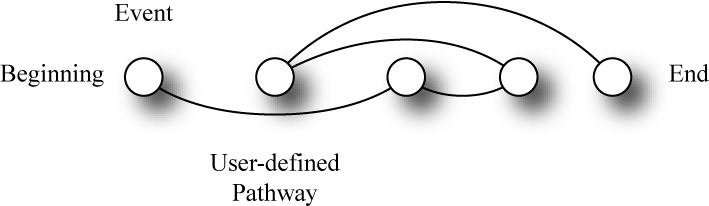
As you may have already guessed, Non linear is the opposite of linear thats why it has "none" in it. The difference between linear and non linear narrative is linear unravels by following the story, not skipping or going forwards or back, just present. Non linear works through having a disjointed narrative which basically means the order of the story is not chronological.
 Having a story in none chronological order could mean a lot of things, but it focuses on being varied, for example the ending could be near the beginning, the beginning could come up near the ending or halfway through. The event would be all over the place, but that's what makes it a movie, to have more style that intriques the audience more giving them more to work from and complicate them. Dreams and flashbacks are possibly key to making non linear a thing, it lets you revisit points from the story or out of the story looking in whichever direction whether its in the future or past, it doesn't need to stay on the present line unlike linear.
Technical Requirements
Sound
Sound comes in all different waves and lengths,(get it? shapes and sizes?) they vary per movie you will rarely find that one movie uses the exact same sound as another, they could use it, but then change the pitch of it, for example explosions in any Michael Bay movie, such as transformers, the sounds coming off them reflect upon what is going on.
The video shows every explosion from T:AoE, at 57 seconds in you can see how a chain of explosions can vary, if they're together it decreases in tone, but the pith always stays the same if no matter the explosion, unless it is some form of metal you notice the explosion sound emmitance reflecting off the metal in a smooth "ping" way. In other parts of the video where they are fighting say the part where the transformers bodies hit off each other or swords hit each other you hear the metal on metal reaction, which sounds as though it came from an anvil, thousands upon thousands of sound can be put together to form just one Michael Bay scene.
Lighting
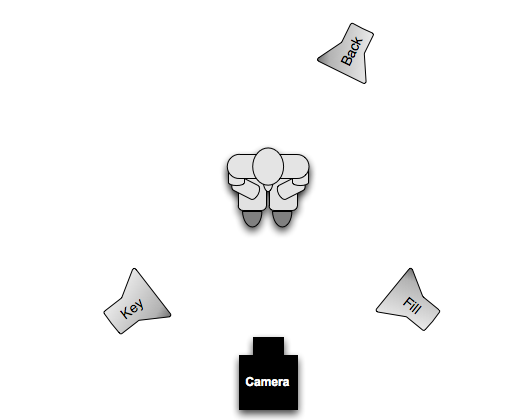
Lighting is key to any production or successful production, the first light would be a key light, second the fill, thirdly the back, these lights are essential to lighting up your subject, not too much not too little, just enough. You wouldn't want to have the perfect scene, not redo-able, possibly revolutionary but the subject is too dark and you can't see them at all.
 The image above is possibly the most commonly used example for the three on point lighting techniques, you can see the different placements of light, first the key light you place near in front of the subject lighting them up dimly, then bring the fill light in to get rid of those un-neccessary shadows that may be on the face of the subject, then the back light which will seperate the subject from the background. You may also see these lighting techniques in Photography and Multi-Camera setups. To adjust the shadow levels of each light you can use one of two options, there is an intensity option(from high grade studio lighting) or possibly changing the distance of the light to the subject
Lighting is key to any production or successful production, the first light would be a key light, second the fill, thirdly the back, these lights are essential to lighting up your subject, not too much not too little, just enough. You wouldn't want to have the perfect scene, not redo-able, possibly revolutionary but the subject is too dark and you can't see them at all.

No comments:
Post a Comment